

What we see on screen is only the final stop in a costume’s much longer journey. Before an actor ever steps onto set, costume designers are reading scripts, researching references, developing characters, sourcing fabrics, sitting through fittings, and figuring out how every piece will actually function in front of the camera. And while no two productions follow exactly the same process, each stage helps turn words on a page into something we can understand visually. Here’s a closer look at how a costume can travel from the script all the way to the screen.


Reading the Script
Research & References
Building the Character
Sketching and Designing
Make, Buy, or Pull
The Fitting
Screen Testing + Aging
Set, Continuity, and the “Final Look”
By the time a costume reaches the screen, most of its journey is already over. What looks like a perfectly placed jacket, worn-in pair of jeans, or elaborate gown may have started with a line in a script before passing through research, sketches, fittings, alterations, camera tests, and plenty of hands along the way. That’s part of what makes costume design so interesting: the best work can feel completely natural, even when an incredible amount of thought went into making it look that way. So, the next time a look catches your eye on screen, remember—you’re only seeing the final draft.
Now lets take a deeper dive into the details with Black Panther: Wakanda Forever…

The sequel presented Carter with two major challenges: dressing a Wakanda mourning the loss of King T’Challa and introducing Talokan, an entirely new underwater civilization. These narrative developments shaped the film’s costume direction, particularly the contrast between Wakanda’s established visual identity and Talokan’s distinctive cultural aesthetic.
Click Here
Carter expanded Wakanda’s Afrofuturist aesthetic through references to African clothing traditions while researching postclassic Maya culture for Talokan. Traditional adornments, historical craftsmanship, and cultural symbolism informed the costumes, helping both civilizations feel distinct without abandoning their historical foundations.

Queen Ramonda’s wardrobe is a particularly strong example of how clothing establishes character. Her elaborate headpieces, sculptural collars, and architectural silhouettes reinforce her authority as Wakanda’s queen. Carter collaborated with designer Julia Koerner to develop intricate accessories that combined traditional visual references with futuristic construction.

Before a costume can be constructed, its design needs to be communicated visually. For Wakanda Forever, Carter’s team developed illustrations that translated the film’s cultural research into recognizable silhouettes, materials, and decorative elements. One particularly useful example is the costume illustration of Namora, published in The Art of Ruth E. Carter. The sketch demonstrates how the character’s elaborate underwater appearance was developed through illustration before becoming a physical costume.

Not every costume comes from a clothing rack. For Queen Ramonda, Carter collaborated with designer and architect Julia Koerner to develop custom 3D-printed pieces, including a new crown and neckpiece. These designs combined advanced fabrication technology with the architectural shapes associated with Wakandan royal dress. The result was a wardrobe that reinforced Ramonda’s authority while extending the film’s Afrofuturist aesthetic. Custom fabrication allows costume designers to create pieces that conventional clothing production cannot easily achieve.
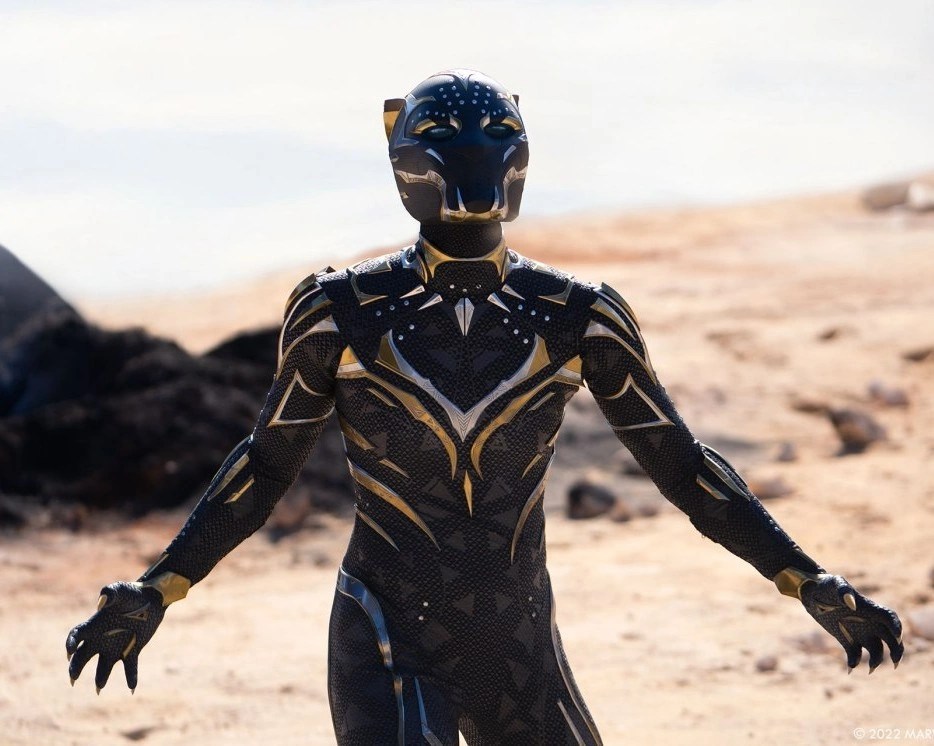
Creating Shuri’s superhero costume required more than choosing the right silhouette. Carter explained that the production created a precise body form of Letitia Wright to develop the suit’s structure. The team considered how to enhance her superhero silhouette without exaggerating her proportions. The costume’s raised details were refined through fittings, while the helmet was tested on Wright and her stunt performers. From the fitting to a screen, a successful costume needs to accommodate the actor’s body and performance while maintaining the intended character design.

For Carter, one of the film’s biggest technical challenges was designing costumes that could actually function underwater. Fabrics behaved differently once submerged, often floating upward instead of creating the intended silhouette. Even the most beautiful design needs to survive the practical demands of filming. The team experimented with weights, attachments, and alternative materials to control how garments moved. They also had to account for how water affected fabric colors and textures.

The costume department’s work doesn’t end once filming begins. Because Wakanda Forever featured extensive underwater sequences, Carter’s team needed multiple versions of certain costumes for different filming conditions. The garments also required frequent adjustments after actors emerged from the water. Carter recalled costumers immediately attending to performers and making corrections between takes. Maintaining a consistent appearance requires constant attention, even when audiences never notice the adjustments happening behind the camera.

Leave a Reply